As we get ready to observe Pain Awareness Month in September, a new scientific review offers timely evidence on a practical approach to pain management: exercise, including mind-body practices such as Tai Chi, yoga, and Pilates.
Published in Pain Reports in July 2026, the study* combined 157 systematic reviews, 2,736 randomized controlled trials, and more than 221,000 participants. Across a wide range of pain conditions, exercise significantly reduced pain. For people who practice or teach mind-body exercise, several findings stand out.
Tai Chi, Yoga, and Pilates All Showed Pain-Reduction Benefits
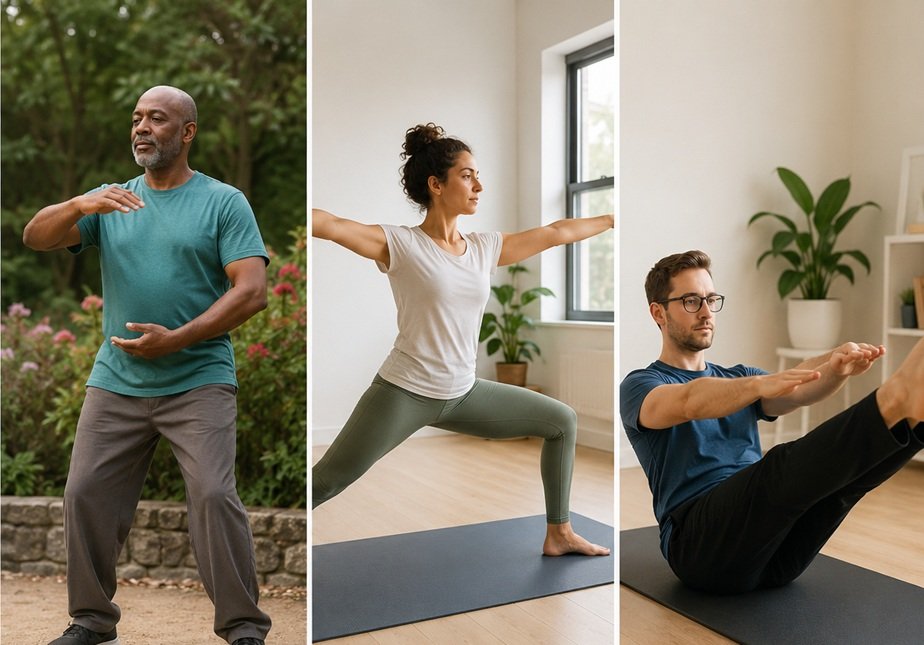
The researchers examined many types of exercise, including aerobic and resistance exercise, aquatic exercise, dance, Tai Chi, yoga, and Pilates.
The overall effect was substantial. On commonly used 1-to-10 pain scales, exercise was associated with an average reduction of about 1.1 points.
Tai Chi, yoga, and Pilates were all associated with significant pain reduction. Both Pilates and Tai Chi showed a large pain-reducing effect:
Pilates: −0.90 (large effect)
Tai Chi: −0.85 (large effect)
Yoga also significantly reduced pain.
These numbers are statistical effect sizes, not percentages of pain reduction. They also shouldn’t be used to rank the exercises because each category included different conditions, participants, and studies.
The key message: there is more than one effective way to move when managing pain.
For Yoga/Pilates Teachers: Tai Chi Adds Another Option
For yoga and/or Pilates teachers, Tai Chi offers another way to help people keep moving when pain limits their options.
While each of the exercises significantly reduced pain in the review, the researchers also emphasize tailoring exercise to people’s preferences, abilities, and circumstances.
Tai Chi expands those choices. Its practice is primarily upright and flowing, with continuous weight shifting, controlled stepping, turning, and coordinated whole-body movement. It requires little equipment or floor work, and movements can be adjusted in range and intensity.
For yoga/Pilates teachers, Tai Chi adds a different approach to pain management. Someone who finds certain yoga/Pilates positions or transitions difficult may be more comfortable with gentle standing Tai Chi movements—or benefit from having both approaches available.
Why Mind-Body Exercise May Be Relevant
Persistent pain can involve changes in how the nervous system processes pain, not just signals from an injured body part.
Tai Chi, yoga, and Pilates combine movement with elements such as breathing, attention, body awareness, postural control, and coordination. The researchers suggest that mind-body approaches may address both physical and psychological dimensions of pain and may be relevant to central sensitization, in which the nervous system becomes more sensitive to pain signals.
The review did not determine how individual practices produce their effects, so it cannot tell us whether Tai Chi, yoga, and Pilates work through different mechanisms.
The Pain Awareness Month Takeaway
For Pain Awareness Month, the message doesn’t have to be “exercise more.”
For people with chronic pain, fear of worsening pain can become a barrier to movement. The researchers support accessible, lower-dose exercise adapted to individual needs.
That may mean shorter sessions, comfortable ranges of motion, modified movements, and lower intensity before gradually progressing.
One of the most useful findings from this review was that lower-intensity exercise was associated with greater pain reduction than moderate-to-vigorous exercise.
New, severe, unexplained, or worsening pain should be medically evaluated, and people with significant health conditions may need professional guidance before changing their exercise routine.
Find a way of moving that works for your body, start at a manageable level, and make movement part of your approach to living with—and potentially reducing—pain.
*Source: Singh B, Miatke A, Dumuid D, et al. “The effect of exercise on clinical pain: a systematic umbrella review and meta-meta-analysis.” Pain Reports. 2026;11(4):e1455.