Online learning offers some obvious advantages for Tai Chi students: lessons can be accessed from home, practice can fit around busy schedules, and instructional videos can be revisited whenever needed.
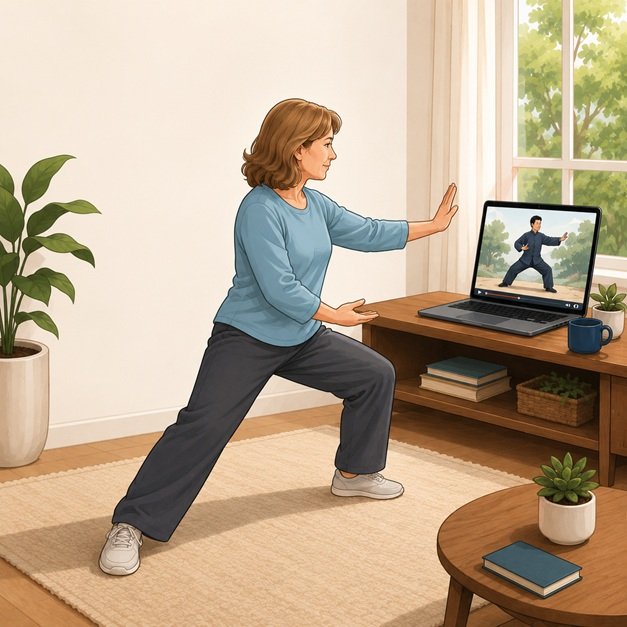
Yet convenience alone does not explain why many students thrive in online Tai Chi programs.
Several studies* of remotely delivered Tai Chi and Qigong programs have found high levels of satisfaction, engagement, and adherence among participants. Researchers are now even designing and refining Tai Chi programs specifically for remote delivery, including for veterans living with post-traumatic stress disorder and chronic pain.
Taken together, these studies point to an important conclusion: online Tai Chi works well not only because it is convenient but also because it offers unique learning opportunities that can support steady, long-term progress.
The research offers several practical clues.
Replay and Repetition: The Online Advantage
One of those insights is repetition.
Unlike an in-person class, online lessons can be paused, replayed, and revisited as often as needed. Difficult sections can be reviewed immediately, and previous lessons remain available for continued practice.
This may seem like a small convenience, but it can significantly improve learning.
Tai Chi is not simply an intellectual exercise. The body learns through repetition. Weight shifting, coordination, balance, and relaxation gradually become more natural through repeated practice. Watching a lesson once is rarely enough. Reviewing it several times often leads to a deeper understanding of both the movements and the principles behind them.
Rather than treating online lessons as videos to watch once, it is more helpful to approach them as learning resources that can be revisited repeatedly and integrated into regular practice. In many ways, successful online students learn differently, not just remotely.
Learn at Your Own Pace
Research has found that participants engage better in online Tai Chi programs when movements are introduced progressively and instruction remains manageable.
This aligns particularly well with one of online learning’s greatest strengths: the freedom to learn at an individual pace.
In an in-person class, the instructor usually determines when the group moves on. Online learning is different. Students can spend extra time on a challenging movement, revisit foundational lessons, or pause before moving to more advanced material.
This is especially valuable in Tai Chi because learning is similar to building a house. The visible forms are important, but the foundation matters even more. Posture, alignment, weight transfer, body awareness, and relaxation are skills that develop gradually and support every movement that follows.
Students sometimes worry that they are progressing too slowly because they have not learned enough forms. Yet one of the hidden advantages of online learning is that there is often no need to rush. Spending additional time mastering the fundamentals frequently leads to better long-term progress than advancing quickly through new material.
In Tai Chi, moving at your own pace is not falling behind. It is often the most effective way to move forward.
Practice Briefly but Regularly
Studies of remotely delivered Tai Chi programs have found good adherence rates, suggesting that participants were able to incorporate practice into their daily lives.
This may be one of the greatest advantages of online learning.
Because lessons are available at home, practice does not require travel, special schedules, or waiting for the next weekly class. Even 10 or 15 minutes of practice can be valuable when done consistently.
Tai Chi benefits from frequency more than intensity. Small amounts of regular practice allow learning to accumulate gradually over time.
Stay Connected and Ask Questions
Research has also found that engagement improves when participants receive support and maintain connections with instructors and fellow learners.
Learning Tai Chi is not a solitary activity. Questions, feedback, and shared experiences all contribute to progress. Sometimes a small correction or clarification can suddenly make a movement feel completely different.
Technology provides the platform, but meaningful learning still depends on interaction and support.
An Easy Way to Stay Connected
Using the comments section under each lesson in our training program is an easy way to take part in our learning community.
Ask questions (we’ll respond there), share your reflections, or let us know how your practice is going. Chances are, if you have a question or insight, other students do, too.
The Takeaways
The research suggests that the most successful online students are the ones who make full use of the strengths of the online environment —
- taking and reviewing lessons at their own pace,
- practicing consistently,
- focusing on fundamentals, and
- staying connected with the learning community.
*Studies referenced in this article:
- Multi-domain Online Therapeutic Investigation Of Neurocognition (MOTION) – A randomized comparative-effectiveness study of two remotely delivered mind-body interventions for older adults with cognitive decline. Contemporary clinical trials, March 2025.
- Protocol for remote Tai Chi and wellness for PTSD and pain in veterans. European journal of psychotraumatology, October 2024.