Highlights
- Why Tai Chi and Yoga Work So Well for Anxiety
- Is Harder Exercise Better?
- A Practical Weekly Practice Plan for Anxiety Support
- A Common Mistake: Stopping When You Feel Better
- What The Studies Mean for Yoga Teachers
If you practice Tai Chi or yoga, you’ve likely felt it: you arrive tense, distracted, or wired… and leave steadier, clearer, and calmer.
Two recent scientific reviews help explain why, and more importantly, how to practice for the strongest anxiety-reducing effects:
- A mechanistic review published in Sports Medicine and Health Science explaining how exercise changes the brain and stress systems.
- A large comparative effectiveness review by Psychology Research and Behavior Management analyzing which types of exercise reduce anxiety most effectively.
Together, they give us both biology and a practical blueprint.
Why Tai Chi and Yoga Work So Well for Anxiety
The comparative review found that regular exercise of many types improves anxiety, and mind–body practices perform very well — especially for people who need lower-impact or sustainable options.
The mechanistic review in Sports Medicine and Health Science explains deeper biology. Tai Chi and yoga influence anxiety through multiple overlapping systems.
1. They Improve Brain Plasticity
Exercise increases BDNF (brain-derived neurotrophic factor), which is often described as fertilizer for brain cells.
Higher BDNF supports:
- Emotional regulation
- Stress resilience
- Neural flexibility
- Mood stability
Regular practice strengthens connections in the prefrontal cortex (your regulation center) and the hippocampus (important for mood and memory).
In simple terms:
You’re strengthening the parts of the brain that calm fear.
2. They Rebalance Brain Chemistry
Exercise influences key neurotransmitters linked to anxiety:
- Serotonin (mood stability)
- GABA (calming effect)
- Norepinephrine (stress responsiveness)
Tai Chi and yoga appear to support calming neurotransmitter balance without overstimulating stress systems — one reason moderate intensity works so well.
3. They Retrain the Stress Hormone System
Chronic anxiety often involves:
- Elevated cortisol
- Poor recovery after stress
- Overactive fight-or-flight response
Regular movement improves HPA-axis regulation (your stress hormone control system). Over time, your body becomes better at activating when needed — and, just as importantly, deactivating afterward.
Tai Chi’s slow transitions and yoga’s breath regulation enhance this down-regulation effect.
4. They Provide Safe Exposure to Sensations
This is one of the most powerful (and underappreciated) mechanisms.
Many anxious individuals fear bodily sensations like:
- Rapid heartbeat
- Muscle tension
- Shaky legs
- Breath changes
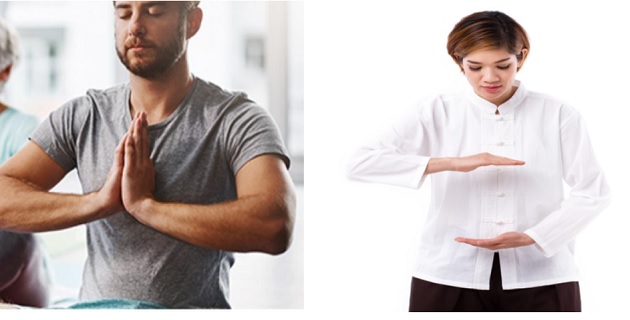
Tai Chi and yoga gently creates those sensations — but in a safe context.
Holding Warrior II
Balancing in Golden Rooster
Sinking into a longer stance
You feel intensity.
Nothing bad happens.
This reduces “anxiety sensitivity” — the fear of physical sensations — which is strongly linked to anxiety disorders.
Is Harder Exercise Better?
The comparative review gives a nuanced answer.
- Moderate-to-vigorous exercise reduces anxiety.
- But extremely intense exercise is not necessarily better.
- Sustainability and consistency matter more than intensity spikes.
For many people with anxiety, moderate intensity is ideal.
That means:
- You feel warm.
- Your breathing deepens.
- You can talk in short sentences.
- You’re challenged but not overwhelmed.
Tai Chi and yoga fit beautifully into this range.
A Practical Weekly Practice Plan for Anxiety Support
Research shows:
- 3+ sessions per week is effective.
- Greater frequency often produces better outcomes.
- Consistency matters more than occasional long sessions.
Here’s how to apply the science directly.
1. Practice 3–5 Days Per Week
Minimum: 3
Ideal: 5
Short sessions are fine. Consistency wins.
2. Use a Three-Phase Session Model (20–40 Minutes)
Phase 1: Gentle Warm-Up (5–10 min)
- Easy joint rotations
- Slow shifting
- Natural breathing
Purpose: transition out of stress mode.
Phase 2: Moderate Challenge (15–20 min)
- Slightly deeper stances
- Continuous flow
- Longer holds
- Controlled balance work
Purpose:
- Raise heart rate mildly
- Create tolerable physical sensation
- Train resilience
Phase 3: Down-Regulation (5–10 min)
- Slower movements
- Breath lengthening
- Standing meditation or seated stillness
Purpose:
- Teach the nervous system how to recover efficiently
A Common Mistake: Stopping When You Feel Better
Many people stop once anxiety improves.
But both bodies of research suggest the benefits are strongest when maintained.
Tai Chi and yoga are not quick fixes. They are ongoing regulation training.
Just like strength fades without lifting, stress resilience fades without movement.
What The Studies Mean for Yoga Teachers
For students who struggle with floor transitions, static holds, or higher-intensity flows, Tai Chi offers another evidence-aligned way to reach the same weekly movement targets (~150 minutes).
The comparative review makes one point very clear: ongoing participation is essential.
Offering both yoga and Tai Chi:
- Provides variety while staying within evidence-based intensity ranges
- Reduces dropout due to physical strain or monotony
- Supports students in maintaining their weekly movement dose
Since total weekly minutes matter, broadening movement formats supports what the research identifies as the most important driver of outcome: consistency.
Tai Chi may be especially accessible for certain populations
Both reviews highlight strong benefits for:
- Older adults
- Individuals under chronic stress
- Those recovering from illness
- People who do not tolerate high-intensity exercise
Because Tai Chi:
- Is upright and low-impact
- Minimizes floor transitions
- Emphasizes moderate, continuous engagement
It can expand a yoga teacher’s ability to serve these research-supported populations while staying aligned with the mechanisms shown to reduce anxiety.
If you’re a yoga teacher looking to expand your offerings, Tai Chi is a powerful complement to what you already teach. That’s why you should try our online Tai Chi training program — beginner-friendly, evidence-based, and fully aligned with the healing principles you already believe in.
🌀 Read our general article here to learn why teaching Tai Chi can be a great option for yoga teachers.
👉 Join our Tai Chi training and expand your impact: