
A new study, published by Front Public Health in March, compared Tai Chi and yoga, two of the world’s most widely practiced mind-body exercises.
Researchers reviewed their health benefits, cultural sustainability, and public health potential. While both practices were shown to support physical and mental well-being, the study also highlighted several areas where each practice appears to offer distinct strengths.
The study also raised an interesting question: beyond health outcomes, what might these two traditions learn from each other as they continue evolving in the modern world?
Two Different Paths to Similar Benefits
The researchers found that both Tai Chi and yoga can improve:
- stress management
- emotional well-being
- anxiety symptoms
- physical functioning
- body awareness
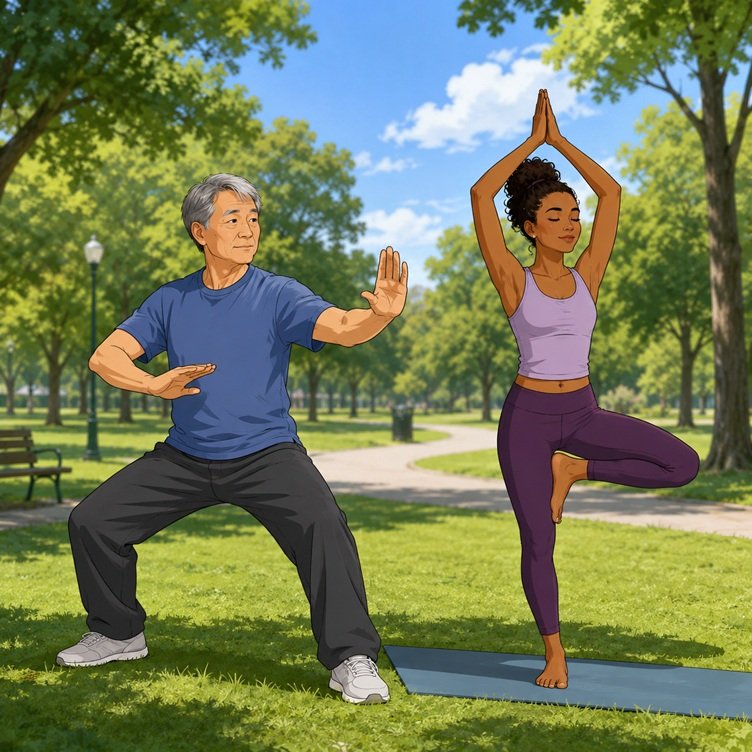
This is not surprising.
Both practices integrate movement, breathing, attention, and relaxation. Both can help practitioners slow down, become more present, and develop greater awareness of body and mind.
At the same time, the study makes clear that Tai Chi and yoga are not simply interchangeable versions of the same practice.
Their methods and areas of emphasis are different.
Where Tai Chi Stands Out
According to the study, Tai Chi showed particular strengths in:
- balance improvement
- fall prevention
- coordination
- blood pressure regulation
- metabolic health
- musculoskeletal support
- long-term exercise adherence
These findings reinforce why Tai Chi is often recommended for middle-aged and older adults.
Tai Chi directly trains skills used in daily life, such as:
- weight shifting
- stepping with control
- directional changes
- coordinated turning
- maintaining stability during movement
These are highly practical movement skills that become increasingly important over time.
The study also highlighted Tai Chi’s strong long-term sustainability. Because it is low impact, adaptable, and mentally engaging, people are often able to continue practicing it for many years.
That may be one of Tai Chi’s greatest advantages.
Where Yoga Stands Out
The study also identified several areas where yoga appears to have particular strengths.
These include:
- flexibility
- short-term stress reduction
- breath awareness
- emotional regulation
- accessibility for people seeking wellness-focused exercise
Yoga’s combination of stretching, breathwork, and meditative practices may help explain why many people experience relatively quick improvements in stress levels and overall mood.
The researchers also noted yoga’s remarkable global reach. Over the past several decades, yoga has successfully expanded into mainstream wellness, healthcare, education, and fitness culture across much of the world.
What Tai Chi Can Learn From Yoga
One of the more interesting parts of the study had less to do with exercise science and more to do with cultural sustainability.
The researchers pointed out that yoga has been highly successful at adapting to modern audiences while maintaining a connection to its traditional roots.
Tai Chi, despite its many strengths, remains less widely understood by the general public.
The study suggests there may be lessons here.
For example, Tai Chi communities could potentially benefit from:
- clearer public education
- more accessible beginner pathways
- stronger outreach to younger generations
- broader integration into wellness and healthcare settings
Yoga has also built a much larger research and educational infrastructure, especially in areas related to mental health and stress management.
Tai Chi research continues to grow, but there is still room for broader public awareness and institutional support.
Of course, modernization brings its own challenges.
As both yoga and Tai Chi become more commercialized and globally adapted, practitioners must continually balance accessibility with preserving the deeper principles of the practice.
A Note for Yoga Teachers
For readers with a yoga background, this study offers an interesting perspective.
While yoga and Tai Chi share many mind-body benefits, Tai Chi adds training in areas such as:
- dynamic balance
- gait and stepping mechanics
- weight transfer awareness
- rotational coordination
- continuous movement transitions
These skills are especially relevant for functional movement and healthy aging.
For yoga teachers working with older adults, Tai Chi may be a valuable addition to an existing movement practice.
Final Takeaway
This study shows that Tai Chi and yoga share many health benefits, but they develop different strengths.
Yoga appears to excel in flexibility, breath-centered relaxation, emotional regulation, and global accessibility.
Tai Chi stands out in balance, coordination, functional movement, and long-term sustainability.
The study also suggests that Tai Chi communities may have something to learn from yoga’s success in public outreach, accessibility, and modernization.
For Tai Chi practitioners, that makes this more than just another health study. It is also a reminder that Tai Chi continues to evolve as a modern practice while remaining rooted in a deep tradition.