Where Tai Chi, Qigong, and Yoga Each Shines for Parkinson’s and Alzheimer’s
September is World Alzheimer’s Month, with World Alzheimer’s Day on September 21 — a timely opportunity to look at new research on how mind-body exercise may support people with Alzheimer’s disease and other neurological conditions.
A recent review offers useful insights into Tai Chi, Qigong, and yoga for both Alzheimer’s and Parkinson’s disease, including their effects on cognition, motor function, mobility, and balance—and where each practice may shine.
Published in Frontiers in Neurology in July 2026, the study* combined results from 28 randomized controlled trials involving 1,429 participants. Twenty-three studies involved people with Parkinson’s disease, while five involved people with Alzheimer’s disease or people at high risk for it. Nine studies used Tai Chi, nine used Qigong, six used yoga, and the remaining studies used other mindfulness-based approaches.
Overall, mind-body exercise produced significant improvements in Parkinson’s motor symptoms, mobility, balance, and some measures of cognitive function. Looking at Tai Chi, Qigong, and yoga separately reveals some useful differences.
Tai Chi: Broad Benefits Across Key Outcomes
Tai Chi was one of the most frequently studied practices in the review, appearing in nine trials. It also showed benefits across a particularly broad range of outcomes.
Motor function
Tai Chi significantly improved motor function in people with Parkinson’s disease.
The studies measured symptoms such as difficulty initiating and controlling movement, rigidity, tremor, and other motor problems using the motor section of the Unified Parkinson’s Disease Rating Scale.
This finding fits well with what Tai Chi actually trains: controlled weight shifting, coordinated movement of the upper and lower body, changes in direction, postural control, and continuous adjustment of balance.
Mobility
Tai Chi also significantly improved performance on the Timed Up and Go test.
This test requires a person to stand up from a chair, walk a short distance, turn, walk back, and sit down. It combines several abilities that are directly relevant to everyday independence: getting up, walking, turning, and maintaining balance during transitions.
These are also skills repeatedly practiced in Tai Chi.
Balance
Tai Chi produced a significant improvement on the Berg Balance Scale, which assesses abilities such as standing unsupported, turning, reaching, transferring between positions, and standing with a reduced base of support.
Tai Chi does not train balance simply by asking someone to stand still. Practitioners continually move their center of gravity while maintaining control. Stepping, shifting weight from one leg to another, turning the waist, and changing direction all require the nervous system to manage balance while the body is moving.
Cognitive function
Tai Chi also showed a significant benefit on the Montreal Cognitive Assessment (MoCA), a test that measures several aspects of cognition, including attention, memory, and executive function.
The average difference favoring Tai Chi was 2.52 points.
This does not mean that Tai Chi prevents dementia or reverses cognitive decline. The number of studies examining cognition was much smaller than the number examining movement. It does suggest that the mental demands built into Tai Chi deserve attention.
When practicing a form, you may simultaneously be remembering a sequence, coordinating the arms and legs, controlling your weight shift, monitoring posture, and directing attention toward the movement. The brain is participating throughout the exercise.
How much Tai Chi did participants practice?
The Tai Chi programs varied, so the review cannot tell us there is one ideal dose.
Several programs used schedules such as:
- 60 minutes, 3 times per week for 12 weeks
- 60 minutes, 2 times per week for 24 weeks
- 60 minutes, 3 times per week for 16 weeks
- 60 minutes, 2 times per week for 12 weeks
Other programs used shorter sessions. One involved 20 minutes three times per week but continued for 10 months, while a simplified six-form program used 45-minute sessions twice weekly for eight weeks.
The common feature was regular practice sustained over time, not an occasional Tai Chi class.
Qigong: Strong on Motor Function and Cognition
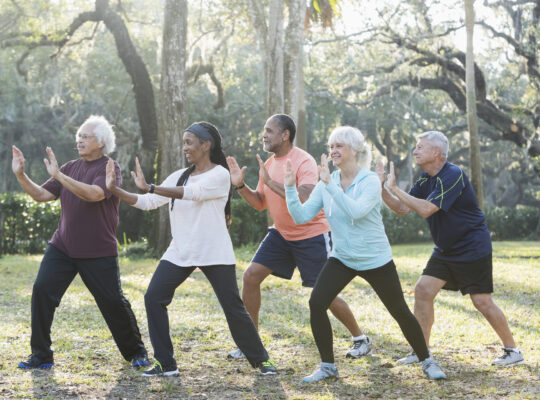
Nine studies involved Qigong. The practices included traditional forms such as Baduanjin (Eight Brocades), Wu Qin Xi (Five-Animal Exercises), and Liu Zi Jue (Six Healing Sounds).
Motor function and mobility
Qigong produced significant improvements in Parkinson’s motor function.
It also significantly improved the Timed Up and Go test, suggesting benefits that can translate into practical movements such as rising, walking, and turning.
These results are noteworthy because Qigong practices can differ substantially from one another. Some involve relatively stationary movements, while others involve more weight shifting, stepping, and coordination.
Despite those differences, the pooled Qigong results showed benefits for both general Parkinson’s motor symptoms and functional mobility.
Cognitive function
Qigong produced a significant improvement on the MoCA cognitive assessment. The average difference was 1.18 points compared with the control groups.
Like Tai Chi, Qigong can require coordination of movement, breathing, and attention. Some forms also require practitioners to remember sequences and continually monitor posture and body position.
What about balance?
The Qigong studies showed improvement on the Berg Balance Scale, but when Qigong was analyzed separately, the result did not reach statistical significance.
That does not establish that Qigong is ineffective for balance. The number and size of studies were limited, and different Qigong forms place different demands on balance.
It does mean that this review provides stronger evidence for Tai Chi and yoga than for Qigong on this particular balance measure.
How much Qigong did participants practice?
Some Qigong programs were relatively intensive.
Schedules included:
- 40 minutes, 5 times per week for 4 weeks
- 60 minutes, 4–5 times per week for 10–12 weeks
- 90 minutes, 3 times per week for 24 weeks
The wide range makes it impossible to identify an optimal dose. But these were structured programs involving repeated practice over weeks or months.
Yoga: Largest Cognitive Gain
Six studies in the review used yoga, including approaches based on Hatha yoga, Kundalini yoga, and power yoga.
Although yoga looks different from Tai Chi and Qigong, it shares an important characteristic with them: physical movement is combined with deliberate attention to the body and, in many programs, breathing and meditation.
Cognitive function
One result stands out: yoga produced the largest numerical improvement in the MoCA cognitive assessment among the three practices.
The average difference was 3.03 points, compared with 2.52 points for Tai Chi and 1.18 points for Qigong.
This does not mean yoga was proven superior for cognition. The subgroup analyses contained relatively small numbers of studies and participants, and the researchers did not conduct a head-to-head trial comparing the three practices.
It does, however, make the yoga findings on cognition particularly interesting and worthy of further research.
Motor function and mobility
Yoga also significantly improved Parkinson’s motor symptoms.
It produced significant improvement on the Timed Up and Go test as well. That suggests the benefits were not limited to performing yoga postures. Participants improved on a functional test involving standing, walking, and turning.
Balance
Yoga significantly improved balance on the Berg Balance Scale.
Yoga can challenge postural control differently from Tai Chi. Tai Chi frequently involves continuous movement of the center of gravity, whereas yoga may require maintaining stability in a posture and controlling transitions between positions.
Both create demands on the systems responsible for balance.
How much yoga did participants practice?
Yoga programs generally involved structured supervised practice, often one or two sessions per week. Some programs also included home practice.
As with Tai Chi and Qigong, the studies differed too much in session length, frequency, and program duration to establish an ideal yoga prescription.
What the Three Practices Have in Common
Tai Chi, Qigong, and yoga can look very different, but the researchers grouped them as mind-body exercises because they combine physical activity with attention, body awareness, and, to varying degrees, breath regulation.
That combination may be important.
These practices ask the brain to process information while the body moves. You may have to recognize where your body is in space, control balance, coordinate different body parts, remember what comes next, and adjust movement based on what you feel.
The researchers describe this in part as motor-cognitive dual-task training. They also discuss possible effects on neuroplasticity, brain connectivity, and nervous-system regulation. These are proposed mechanisms; the study does not prove exactly how Tai Chi, Qigong, or yoga produces the observed benefits.
For practitioners, there is a simpler lesson: the mental component of mind-body exercise should not be separated from the physical one.
In Tai Chi, pay attention to weight transfer, balance, coordination, and movement direction.
In Qigong, coordinate posture, movement, breathing, and attention rather than repeating movements mechanically.
In yoga, maintain awareness of body position, balance, and breathing as you enter, hold, and leave postures.
The study does not prove that greater mental attention produces greater neurological benefits. But attentive movement is a central feature of the practices that were studied.
The Practical Takeaway
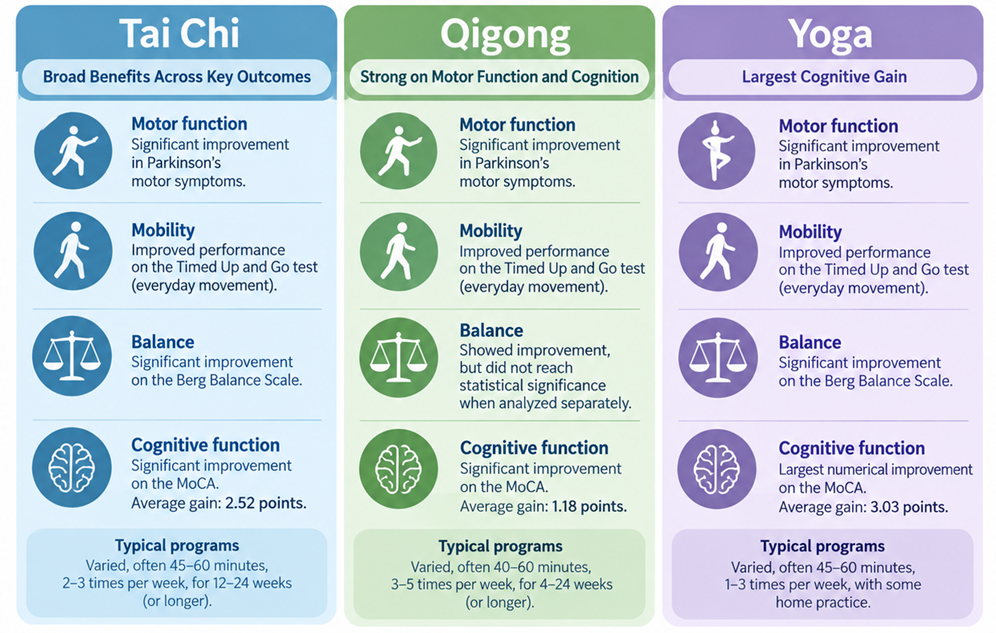
This review does not identify a winner among Tai Chi, Qigong, and yoga. Instead, the researchers describe these practices as adjunctive interventions, and each practice demonstrated particular strengths.
Tai Chi stood out for the breadth of its findings, with significant benefits for Parkinson’s motor symptoms, mobility, balance, and cognitive function.
Qigong showed significant benefits for motor symptoms, mobility, and cognitive function, although its balance result did not reach statistical significance when analyzed separately.
Yoga showed benefits for motor symptoms, mobility, and balance and had the largest numerical cognitive improvement among the three practices.
Across all three, one theme stands out: these are not exercises in which the body works while the brain takes a break.
They require attention, coordination, and body awareness while moving. Regular practice therefore provides a combination of physical and cognitive challenge that may be particularly relevant as we age.
For people who already practice Tai Chi, Qigong, or yoga, the message is practical: practice regularly, stay mentally engaged in what you are doing, and keep giving both your body and your brain something to work on.
Source: “Effects of mindfulness-based exercise on Parkinson’s disease and Alzheimer’s disease: a systematic review and meta-analysis.” Frontiers in Neurology, July 30, 2026.